Chinese Animal Lanterns: Frame, Covering and Light Form One Design
A three-dimensional animal lantern is both an object and a lighting design. Its frame holds the volume, its covering carries color and its illumination changes what the audience sees. Shanghai’s documented lantern practice offers a useful way to study those layers without assuming every Chinese lantern uses the same materials.
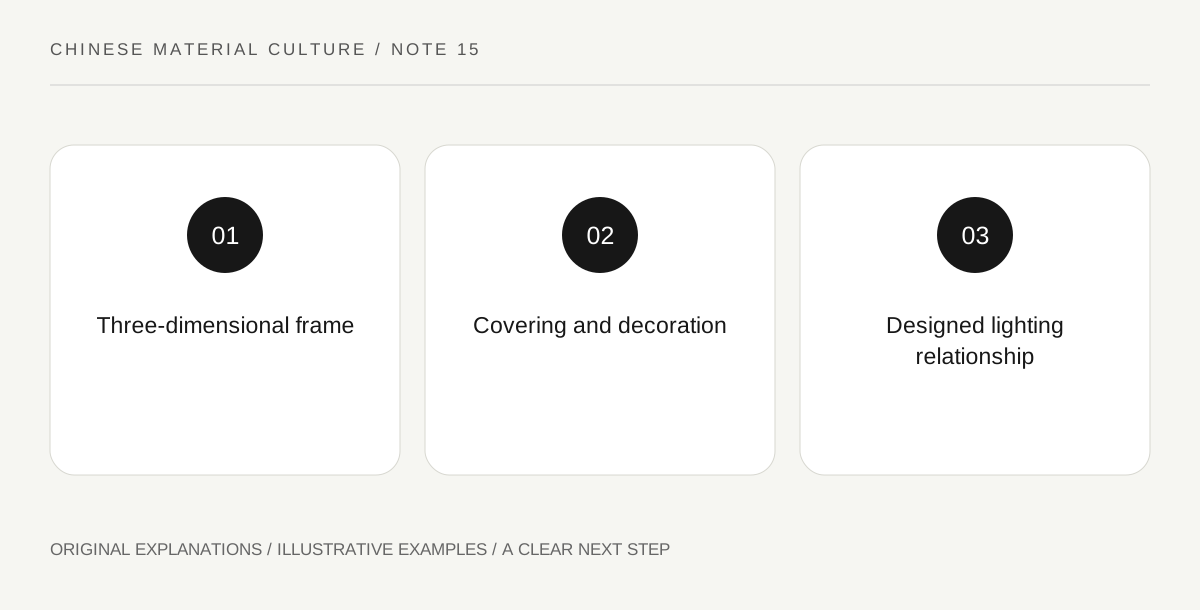
Original explanatory diagram. Read the full method and limitations below.
Identify the structure hidden inside the animal
Shanghai’s craft introduction describes animal lanterns made through concept design, wire framing, silk covering, decoration and lighting. Begin with volume rather than surface pattern. Ask which lines hold the body shape and which are decorative additions. A photograph taken in daylight can make the covering seem like the entire object, while a construction view reveals a skeleton of relationships. Keep the specific tradition named; another region or maker may use different materials. The task is to understand how this documented object is organized, not to assign one construction method to every lantern across China.
Compare the lantern in daylight and when lit
If permitted images show both states, note what changes. Some structural lines may become more apparent, colors may read differently and the relationship between opaque and translucent areas may matter more. Describe what the views show rather than claiming that a particular glow proves the covering is silk. A photograph also depends on exposure and surrounding light. Use the maker’s material account for composition and the paired images for visual comparison. This makes light an active part of the design while keeping the limits of photographic evidence clear. No physical probing or opening of the object is required.
Make a non-electrical volume study
An original paper model can explore the idea without creating a working lantern. Draw a simple animal profile twice on card and use broad connecting paper bands to suggest volume between them. Label profile, connecting structure and imagined covering, then compare the model from the front and side. The exercise is a spatial sketch, not a traditional lantern pattern, electrical project or load-bearing display. Do not add a candle or improvised lamp. A maker-built lighting system has requirements that are outside the paper model’s purpose. The model is successful if it explains why one flat outline cannot describe the whole animal form.
Keep regional continuity and material change visible
The Shanghai account explicitly discusses changes in framing and lighting materials. Zhongshan’s Xiaolan documentation shows a different bamboo-frame and paper-covering process. Those examples make a useful comparison: an inherited craft can be studied through both continuity of purpose and particular material choices. Avoid claiming that a modern wire or electric element automatically makes a work less authentic, or that a bamboo frame guarantees age. Ask the maker what tradition, adaptation and intended setting the piece represents. Display, transport and safe operation belong to its actual instructions, not to a guess based on how light the object appears.
Illustrative volume comparison
A learner makes a plain card-and-paper model of an invented bird with two side profiles and connecting bands. A separate drawing shows where a covering and lighting would be located in a real lantern, but neither is installed. The model is compared with documented Shanghai and Xiaolan construction accounts, with each region’s materials kept distinct.
Practical checks
Optional checkboxes save only in this browser.
Questions that come up
Are all Chinese lantern frames made from bamboo?
No. The cited Shanghai example uses wire, while Xiaolan documentation shows bamboo construction. Describe the particular tradition and object rather than assigning one material to the whole category.
Can I put a candle in an ordinary paper practice model?
This exercise is not designed as a functioning lantern. Keep it as a non-electrical spatial study and use only properly designed products according to their instructions for actual lighting.
References and scope
These sources support the factual background. Examples and exercises are original illustrative teaching material. References do not imply endorsement.
- Shanghai: lantern and velvet-embroidery crafts — Wire-frame animal lanterns and wool-based velvet embroidery.
- Zhongshan: Xiaolan lantern makers — Bamboo-frame preparation and paper covering in a local lantern tradition.