Beijing Swallow Kites: Read the Bird Shape and Its Structure
Beijing’s swallow-shaped kites are recognizable through an expressive head, spread body and forked tail. Their appearance belongs to a regional toy and craft tradition, while a functioning kite also depends on its construction and intended use. Study the form without assuming every beautiful display piece is ready to fly.
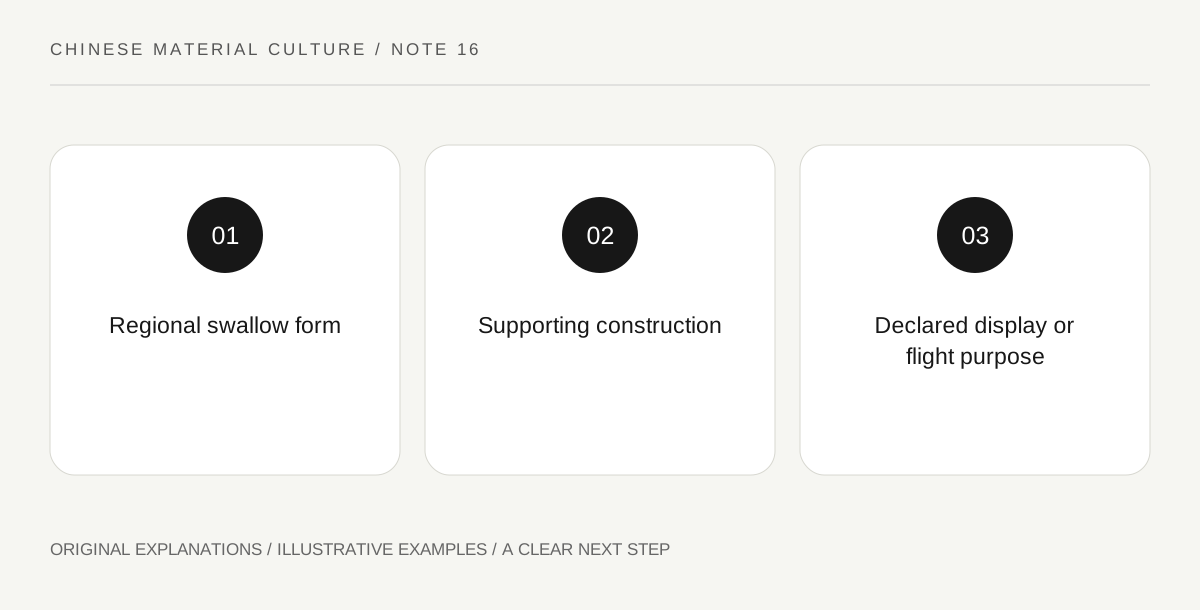
Original explanatory diagram. Read the full method and limitations below.
Name the local form before generalizing
Beijing’s official magazine describes the swallow-shaped zhayan or shayan kite and several variations within that local form. Keep those names and the location beside your observation. The article connects the returning swallow with seasonal and auspicious associations in that setting. That provides a documented context, not a dictionary assigning the same meaning to every bird image in China. A kite shaped like another creature or made in another region should be read through its own maker’s description. Specificity makes the familiar silhouette more interesting than a vague label such as ancient Chinese decoration.
Draw the silhouette in a few major parts
For a purely visual study, draw an original broad head, spread body and scissor-like tail, then compare the proportions. Change one part on a second sketch and notice whether the overall bird reads differently. This is an observation exercise inspired by a documented form, not a historical pattern or flight-tested plan. Keep the design on paper rather than adding an improvised frame and line. A successful drawing communicates how several parts cooperate in the silhouette. It does not need to copy the distinctive painted details of a named artisan or claim membership in a particular kite-making family.
Separate painted image from working structure
A display photograph can show ornament clearly while concealing frame connections and the arrangement required for flight. Ask a maker to identify the structural parts of a functioning product and explain its intended conditions of use. Do not assume a symmetrical front image tells you everything about balance or attachment. If a museum provides a rear or construction view, compare it with the front and record how the structure supports the visible form. The point is seeing that decoration and function must be coordinated, not reverse-engineering a flight device from an attractive image without sufficient information.
Choose display or flight as an explicit purpose
If purchasing a current kite, ask whether it is made for hanging, teaching or flying and retain its actual instructions. Fragile ornament can be appropriate for display without being defective. A working kite still needs suitable local permission and conditions for use, which a craft-history article does not establish. Do not test an unknown or historic object by tensioning its frame or pulling its line. In a cultural note, keep form, declared materials, maker and intended purpose separate. That makes it possible to appreciate a small souvenir honestly without inventing a historical pedigree or technical performance claim.
Illustrative silhouette page
A learner draws two invented swallow-inspired silhouettes with different tail proportions and labels them original visual studies. A note beside them summarizes the documented Beijing form. The learner then uses a maker’s construction image to distinguish frame from painting. No sketch is described as flyable, and no testing result is claimed.
Practical checks
Optional checkboxes save only in this browser.
Questions that come up
Does every swallow design have one universal meaning?
No. The cited association belongs to the documented Beijing context. Identify the source and setting instead of transferring it automatically to every bird motif.
Can an attractive souvenir kite always be flown?
No. Some objects are intended for display or teaching. Ask the maker about intended use and instructions rather than treating decoration as a performance guarantee.
References and scope
These sources support the factual background. Examples and exercises are original illustrative teaching material. References do not imply endorsement.
- Beijing magazine: toys and imperial crafts — Swallow-kite forms, filigree inlay and local craft context.