Chinese Bamboo Weaving: Follow the Strip Through the Pattern
Bamboo weaving transforms narrow elements into useful surfaces and forms. Following one strip is often more revealing than staring at the finished pattern as a whole. Begin with a simple paper analogy, then look at how a documented Chinese woven object handles changes of direction, spacing and the edge.
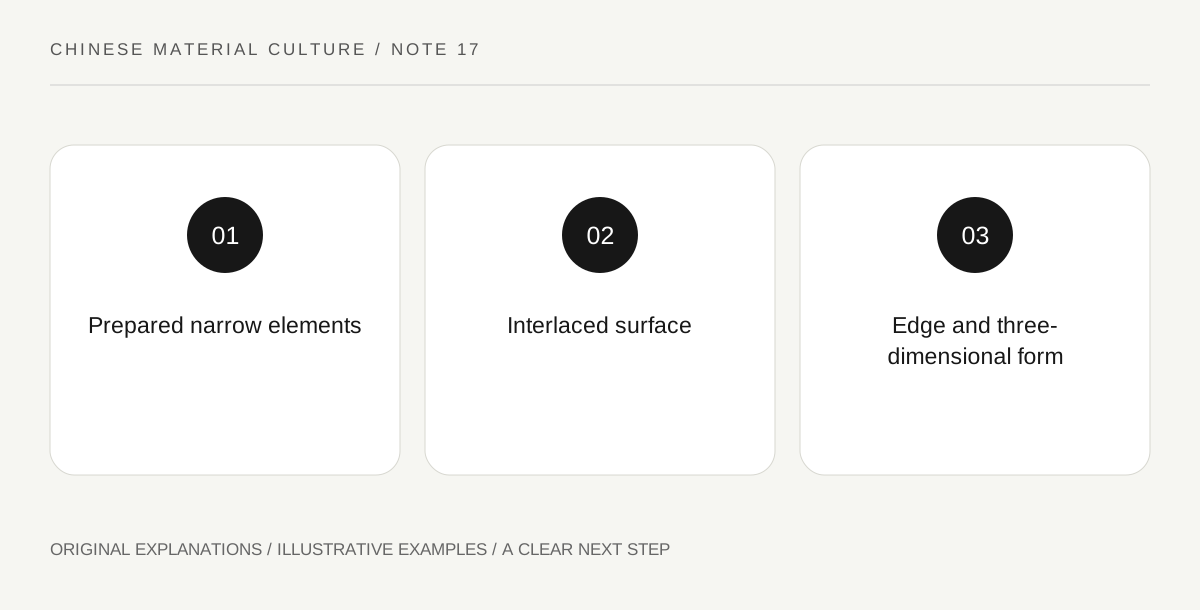
Original explanatory diagram. Read the full method and limitations below.
Keep the craft attached to a local material setting
Shanghai’s account of Qibao describes a bamboo-weaving industry associated with locally available bamboo and daily-use objects. That is a useful reminder that the material’s practical availability matters alongside decorative skill. It does not establish one universal Chinese weaving pattern or a date for every basket. When looking at another documented object, record its location, maker and materials if known. Bamboo, rattan and other narrow materials should not be treated as interchangeable merely because their finished colors look similar. The label’s composition and the visible interlacing answer different questions.
Trace one element rather than the entire pattern
In a clear image, choose one visible strip and follow where it passes above and below neighboring elements. Mark interruptions where the view does not reveal the route instead of inventing a continuous path. Then trace a neighboring strip and compare the repeat. This makes the structure easier to understand than trying to name a complex pattern immediately. The surface may include more than one type of element or direction, so a single traced line is only a local observation. Keep it attached to the section of the object that the image actually shows.
Use paper to understand interlacing
For an original adult practice exercise, lay several broad paper strips in one direction and thread another strip alternately over and under them. Add a second crosswise strip with the opposite starting relationship and compare the resulting repeat. Keep the first sample flat and simple. It is a paper model of interlacing, not a traditional bamboo pattern or a finished basket. Real bamboo preparation, splitting and edge treatment involve material properties and tools outside the exercise. Labeling the analogy clearly lets it teach structure without claiming that a few minutes with paper reproduce a specialist craft.
Study the edge and change of shape
A woven surface has to end somewhere, and a useful object also changes direction from base to side or into a rim. Examine a documented image for how the maker handles those areas. The edge may reveal construction decisions that the regular middle pattern conceals. Avoid flexing an unknown object to inspect a joint or assuming an open weave can carry any intended load. If buying a contemporary item, ask what use and care the maker specifies. A decorative tray, an ornamental container and a working carrying basket need not have identical performance. The structural reading should make those distinctions more visible, not become an improvised strength test.
Illustrative flat-weave sample
A learner uses broad paper strips to make a small alternating over-and-under rectangle, then draws the route of one strip. The sample is left flat and labeled as an interlacing analogy. A separate photograph of an identified bamboo object is studied for its rim, with unknown construction details marked as questions rather than reconstructed by guesswork.
Practical checks
Optional checkboxes save only in this browser.
Questions that come up
Is every brown woven basket made from bamboo?
No. Appearance alone does not identify the material. Use the maker or museum record to distinguish bamboo from rattan and other materials.
Does a flat paper weave teach complete bamboo basket making?
No. It demonstrates interlacing only. Preparing bamboo, shaping a vessel and finishing its edge involve additional material knowledge and specialist skills.
References and scope
These sources support the factual background. Examples and exercises are original illustrative teaching material. References do not imply endorsement.
- Shanghai: Qibao bamboo-weaving history — Locally sourced bamboo woven into daily-use objects.