Longquan Celadon: See the Glaze as a Process
A celadon surface is more than a green color chosen from a palette. Longquan’s documented tradition connects prepared glaze, the ceramic vessel and closely controlled firing. Looking at those relationships helps explain why superficially similar green objects can belong to very different materials and production histories.
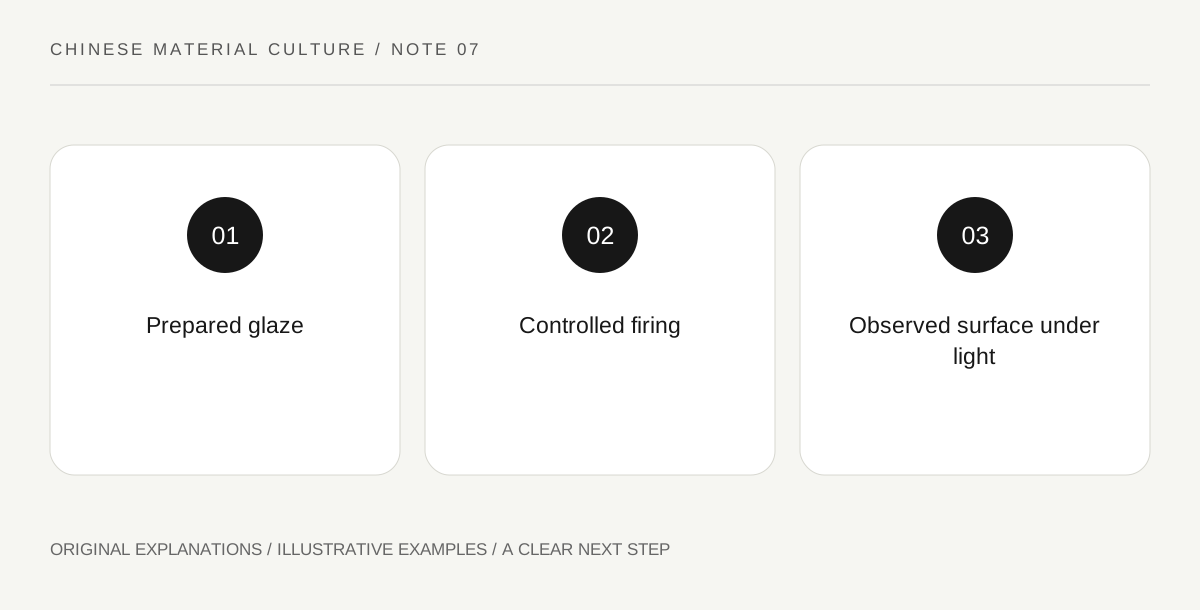
Original explanatory diagram. Read the full method and limitations below.
Separate vessel form from surface effect
Start by describing the object’s shape, then its visible surface. A bowl’s rim, foot and profile belong to form; glaze color, pooling and any visible texture belong to the surface description. These fields interact but are not interchangeable. UNESCO’s Longquan account emphasizes a traditional firing technology that produces a distinctive glaze. That makes process a useful question whenever a shop label simply says celadon. Ask whether the label identifies a documented regional product, a general appearance or a style-inspired contemporary object. Those are different descriptions, even when all may be attractive.
Read the glaze and firing together
The UNESCO description includes a glaze prepared from mineral and other ingredients and repeated controlled heating and cooling. Its details show that the final result depends on more than brushing a colored liquid onto a pot. For a beginner, the important lesson is the connection between preparation, application and firing control. This article does not translate a heritage description into a home-kiln recipe. Materials, equipment and specialist judgment cannot be inferred safely from one paragraph. In a studio visit, ask what stage is being demonstrated and how the maker evaluates its result, keeping actual firing work within qualified instruction.
Compare light across one surface before comparing objects
In a museum image or permitted viewing setting, notice how the same glaze appears on a broad area, near a curve and at a recessed feature. Reflections can change what looks like the color, so avoid calling every bright highlight a different glaze. Describe what you can see without manipulating the object or applying liquids to test it. If comparing photographs, record that their lighting conditions differ. A more informative note says the surface looks deeper in a recess under this view than announces a precise glaze formulation from a screen. Observation gains value when its conditions remain visible.
Do not make crackle a shortcut to authenticity
The heritage account describes different Longquan celadon styles, including a crackle effect in one described variety. That does not make crackle a universal age test, a guarantee of quality or evidence that every cracked green pot belongs to Longquan. Let an identified object’s record establish its material and history. For a contemporary purchase, request the maker’s use and care information and distinguish decorative display from food service. A cultural explanation of a glaze does not certify the safety or durability of an unknown vessel. Appreciate the surface while keeping those separate questions grounded in appropriate evidence.
Illustrative surface note
A learner studies one documented bowl through two permitted photographs and separates form, visible glaze behavior and lighting in three columns. A dark-looking recess is recorded as an observation rather than a chemical diagnosis. The learner then reads the maker or museum’s process description. The exercise connects looking with evidence without using crackle as an antique test.
Practical checks
Optional checkboxes save only in this browser.
Questions that come up
Does celadon just mean any green ceramic?
The word can be used broadly in commerce, but the cited heritage account concerns a particular Longquan tradition and firing technology. Ask what the specific product description establishes.
Does a crackled glaze prove that a pot is old?
No. Surface appearance alone does not date a vessel or identify its production history. Use provenance and appropriate expertise for historical claims, and maker information for current product use.
References and scope
These sources support the factual background. Examples and exercises are original illustrative teaching material. References do not imply endorsement.
- UNESCO: Longquan celadon — Verified page title is Longquan celadon despite legacy URL slug; controlled glaze firing.