Chinese Seal Engraving: Why the Design Must Be Read Twice
A seal has two related images: the carved face and the impression it leaves. They are reversed across contact, so a design that looks correct on the block may print incorrectly. Understanding that relationship helps you appreciate seal engraving before attempting any specialist carving.
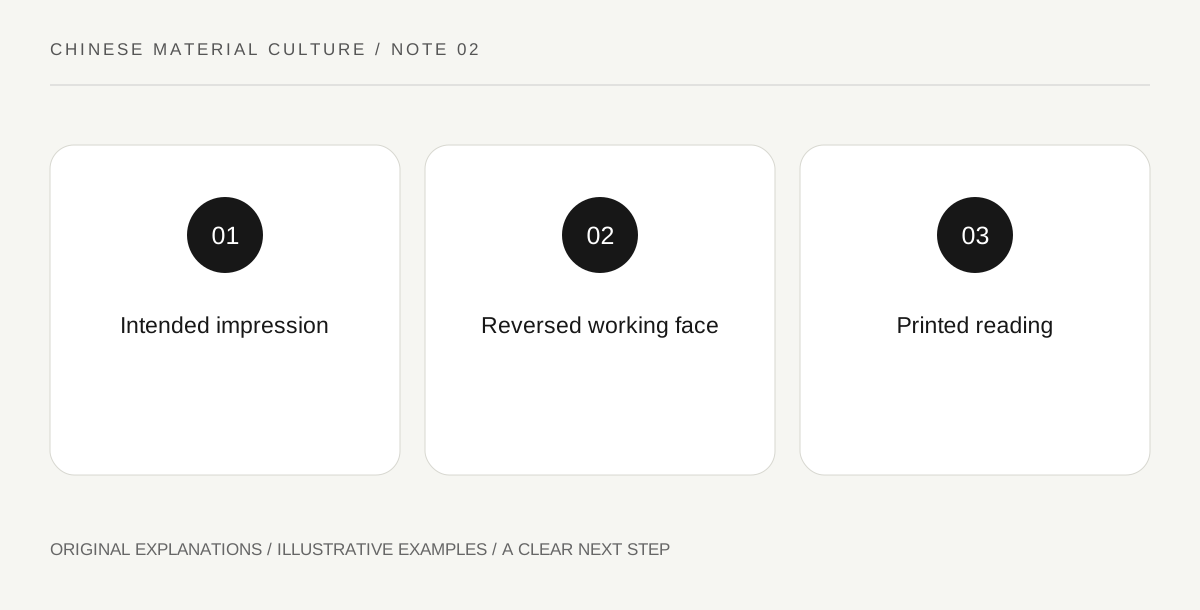
Original explanatory diagram. Read the full method and limitations below.
Distinguish the object from its impression
UNESCO describes seal engraving as a practice involving a design first drawn on paper and then engraved in reverse on stone. For a beginner, the key is that the final reading occurs on the receiving surface. Look at a documented seal and impression together if both are available. Ask which image is the working face and which is the intended mark. This removes a common source of confusion when characters look unfamiliar. The object is also a work in its own right, so its handle, material and physical scale can matter alongside the printed image.
Test reversal with paper rather than stone
Draw an original asymmetrical shape, such as a flag with a small dot on only one side, on a transparent or translucent practice sheet. Turn the sheet over to see its reversed arrangement. Compare that with the intended mark on another sheet. The exercise teaches the relationship without pretending to reproduce the tools or skill of an engraver. A simple invented emblem is sufficient to make the change visible. Label both views so someone examining the exercise later understands which one represents the design that will be read and which one represents its contact surface.
Understand how a tiny field organizes attention
The UNESCO account emphasizes the significance of line thickness and curves within a small surface. Study the balance of dense and open areas in a documented impression rather than judging only whether you can read every character. Note how the shape of the border, spacing and visual weight relate. A compact mark may need careful adjustments that differ from drawing the same forms at poster size. If a workshop introduces letter forms or scripts, follow the instructor’s explanation and identify any adaptation as such. Your inability to read a script does not make the design meaningless, but it does limit what you can claim about its text.
Keep an art purchase separate from authentication
A contemporary decorative seal, a commissioned name seal and an old object with a provenance claim are different propositions. Ask a maker what material, design and service are actually being offered. A red impression by itself cannot prove age, ownership history or attribution. Likewise, an impressive stone handle does not establish the quality of its engraved face. If buying a name seal, confirm the text with someone competent to read it and review the intended impression before agreeing. Specialist cutting tools and stone work belong in qualified instruction; a paper reversal study already provides a meaningful first lesson.
Illustrative asymmetric emblem
A learner designs a small flag with a dot to its right and labels that drawing intended impression. The learner flips a tracing to create a separate working-face view. Comparing the two makes the reversal visible. The emblem is an original teaching symbol, with no claim to reproduce a historical artist’s design or a working document stamp.
Practical checks
Optional checkboxes save only in this browser.
Questions that come up
Why not draw readable characters directly on the seal face?
The contact impression reverses the face. The design must be prepared with that relationship in mind, which is why UNESCO’s account explicitly describes reverse engraving.
Can a clear red impression authenticate an antique seal?
No. It shows the mark produced by a face, not the object’s full history. Age, authorship, material and provenance require evidence beyond one attractive impression.
References and scope
These sources support the factual background. Examples and exercises are original illustrative teaching material. References do not imply endorsement.
- UNESCO: Chinese seal engraving — Design, reverse engraving and the seal as art and mark.