Chinese Woodblock Printing: Raised Areas, Proofs and Corrections
An engraved printing block carries an image through its surviving raised surface. The cuts and the inked areas play different roles, while proof impressions reveal problems that the block alone may hide. Understanding that sequence makes a printing demonstration easier to follow and a finished page easier to read.
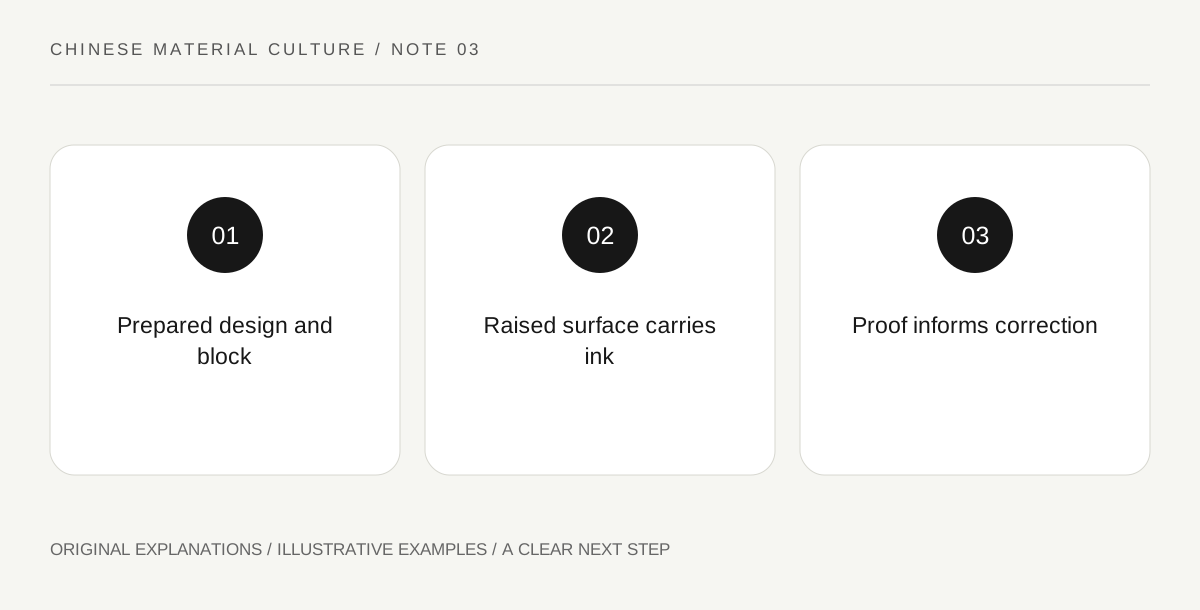
Original explanatory diagram. Read the full method and limitations below.
Ask which surface touches the paper
UNESCO’s account of Chinese engraved block printing describes designs cut into prepared wood so raised characters apply ink to paper. That is the central relief-printing relationship. In a demonstration, identify the remaining printing surface before concentrating on the tools. A dark groove on the block may appear visually strong yet not behave like a raised ink-carrying line. Compare the block with its impression to see what becomes dark and what stays light. This question is more instructive than assuming that everything visible on the block is transferred in the same way.
Keep preparation and carving in the sequence
The heritage description includes preparation of the wood, checking the draft and transferring the design before carving. These stages explain why a master demonstration can look quick at the moment of printing while depending on substantial prior work. Ask which step the demonstrator is showing and what has already been completed. Do not call the final pressing the entire craft. A classroom illustration can use a clearly labeled drawing of raised and removed areas instead of specialist carving. Actual cutting should follow qualified instruction with appropriate materials, tools and handling rather than an improvised imitation based on a short description.
Read a proof as information rather than a failure
The cited account describes testing blocks and making corrections before final use. A proof gives the artisan a view of the design in its printed state, where gaps, unwanted marks or uneven relationships become easier to judge. Study a documented proof beside a later impression if a workshop provides them. Ask what specific adjustment is being evaluated. Avoid interpreting every irregular mark as poor workmanship; it may be a provisional stage or the result of the particular demonstration conditions. The useful distinction is between a purposeful proof, an intended final edition and an accidental defect in a particular impression.
Distinguish printing technique from reproduction claim
A hand-printed page can be a contemporary design, a reproduction of an earlier work or part of a book produced in a traditional format. Technique alone does not tell you which. Read the maker’s label and ask what the source image and edition description mean. If several colors or blocks are involved, ask how the demonstration keeps them aligned rather than assuming one block printed everything at once. A good note records block preparation, proofing and the role of the printed object. It need not declare that hand production is automatically older or more valuable than another kind of reproduction.
Illustrative relief diagram
A learner draws a square block with one raised dark stripe and two cut-away pale areas, then draws the resulting paper mark alongside it. A second diagram adds an unwanted raised speck and shows how it appears in a proof. The exercise explains correction without requiring a knife or copying a historical illustration.
Practical checks
Optional checkboxes save only in this browser.
Questions that come up
Does a carved groove always print a dark line?
Not in the relief relationship described here. The raised surface transfers ink. Compare block and impression before assuming the darkest-looking feature on the block will be the darkest printed feature.
Does hand printing prove a page is old?
No. Traditional techniques can produce contemporary work and reproductions. Date, source image, edition and provenance are separate claims that need their own evidence.
References and scope
These sources support the factual background. Examples and exercises are original illustrative teaching material. References do not imply endorsement.
- UNESCO: engraved block printing — Wooden relief blocks, transfer, proofing and hand printing.