Wooden Movable Type: Composing a Page From Reusable Characters
A woodblock holds a page as one engraved design; movable type assembles a page from separate characters. That difference changes the work of composing, checking and reusing the printing material. Rui’an’s documented genealogy-printing tradition shows why the craft includes language and community knowledge as well as manual skill.
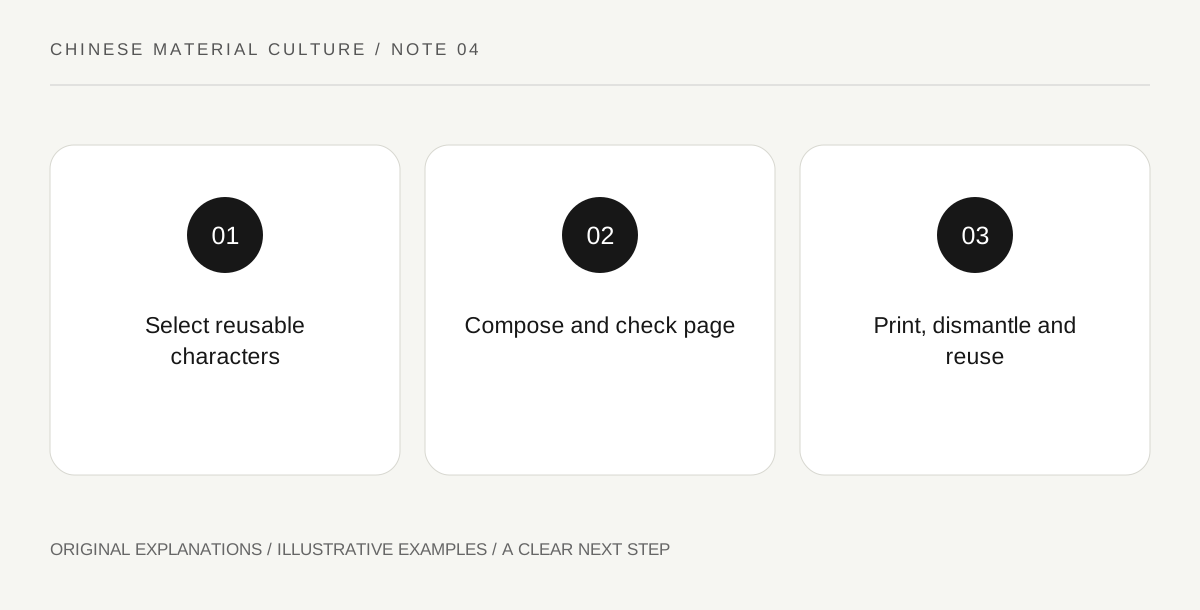
Original explanatory diagram. Read the full method and limitations below.
Distinguish a whole-page block from separate type
UNESCO’s account of wooden movable-type printing in Rui’an describes individual carved characters arranged into a type-page and later dismantled for reuse. Imagine the difference between drawing a whole sentence on one board and assembling the sentence from separate labeled pieces. The printed result can look orderly in both cases, but the underlying preparation is different. In a workshop, ask to see the type before the page is locked into its printing arrangement. A finished book page alone may not make the production method obvious to a beginner.
Model composition with ordinary paper tiles
For an original exercise, write one short English phrase on a sheet, then make separate paper tiles for each letter and space. Arrange the tiles in the intended reading order and compare them with the written phrase. The paper model is not a replica of Chinese type or a statement that alphabetic and character-based printing have identical demands. It simply makes independent units and their order visible. Introduce one duplicate and one missing tile, then notice how both errors affect the result. A correct pile of pieces does not guarantee a correctly composed page.
Give checking its own place in the process
The heritage account connects the practice with historical knowledge and language mastery in compiling genealogies. That explains why selecting and arranging pieces is more than matching shapes. A name, relationship or sequence can be wrong even when every impression is clear. In a demonstration, ask how the content is checked before and after printing and who holds the knowledge needed to resolve uncertainties. Do not treat a family record as decorative text for casual copying. If using an original practice phrase, proof it against the intended wording and mark corrections visibly before imagining the printing stage.
Understand reuse within its community setting
After a type-page is dismantled, characters can be used again, but the next text still requires composition and checking. Reuse saves a kind of material preparation without eliminating the expertise of the printer. UNESCO’s account also situates the work in community genealogy production and transmission through families. Avoid repeating an old practitioner count as if it described the present day; a heritage nomination records a particular moment. The useful enduring lesson is the relationship between reusable material, skilled content work and a community purpose. A demonstration souvenir should be described by what it is, rather than treated as an authentic family record merely because movable type produced it.
Illustrative paper composition
A learner assembles the phrase PRINT ONE LINE from individual paper tiles, checks it against the original and discovers a repeated letter and missing space. After correction, the tiles are separated and reused for a different phrase. The model demonstrates composition, proofing and reuse while explicitly remaining an alphabetic classroom analogy, not a Chinese genealogy-making lesson.
Practical checks
Optional checkboxes save only in this browser.
Questions that come up
Does reusable type eliminate page preparation?
No. Individual characters can be reused, but the new page still needs composition, checking and preparation for printing. The reusable units and the finished page are different levels of work.
Is a paper-letter model a replica of Rui’an printing?
No. It is an analogy showing independent units and order. Chinese character selection, historical language knowledge, actual printing equipment and community genealogy practice involve additional expertise.
References and scope
These sources support the factual background. Examples and exercises are original illustrative teaching material. References do not imply endorsement.
- UNESCO: wooden movable-type printing — Rui’an genealogy printing, reusable characters and composing.