Xuan Paper: Read the Fiber Story Before the Rice-Paper Label
The English phrase rice paper can hide more than it explains. Xuan papermaking has a particular material and regional history, and a modern sheet sold for brushwork needs its own description. Begin with fibers, process and intended use rather than assuming every pale Asian-style paper is the same product.
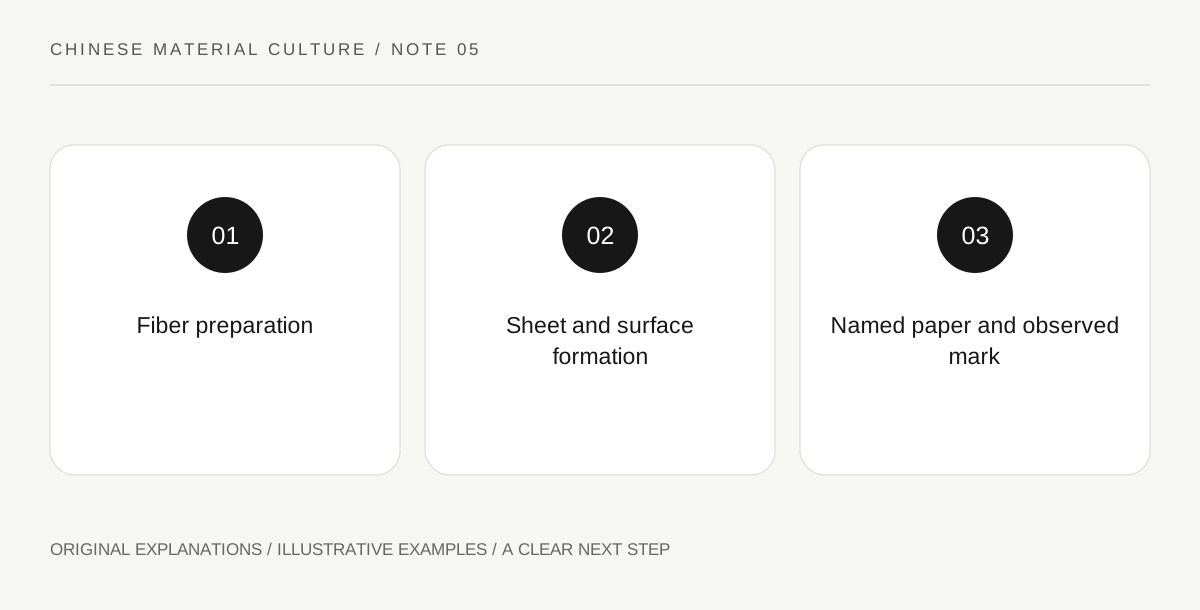
Original explanatory diagram. Read the full method and limitations below.
Separate a broad shop label from a named tradition
UNESCO identifies Xuan papermaking with Jing County in Anhui and describes materials including bark and rice straw. That makes the loose English label rice paper inadequate as a complete account. A sheet may contain a rice-related material without being made only from rice, while another product may use the phrase commercially for something else. Read the actual maker’s material description and intended use. Do not transfer the Xuan name to every translucent sheet on a craft-shop shelf. The first useful question is what product is being offered, not whether the package has an appealing brush-painted picture.
See the sheet as the result of many stages
The heritage account describes a long sequence of hand processes involving preparation, washing, pulping, drying and finishing among other stages. The finished surface therefore condenses work that is invisible if you see only a stack of white sheets. In a demonstration, ask which stage is shown and what material has already been processed. A moment of lifting a sheet from water is meaningful but not the entire craft. An explanatory diagram can group stages into fiber preparation, sheet formation and finishing without inventing a shortcut that claims to reproduce the inherited process at home.
Make a labeled comparison of ordinary practice papers
If exploring brush marks, use inexpensive papers whose product descriptions you can retain, and keep any historical or valuable sheet out of the experiment. On each practice sample, make the same simple original mark with an appropriate writing medium used according to its instructions. Record the paper label, the tool and your observation of the mark’s edge and spread. The result is a comparison of those samples under those conditions, not a test proving authentic Xuan origin. Changing the liquid amount or tool at the same time would make it difficult to tell which difference came from the paper.
Connect material behavior with the intended work
A paper useful for one kind of mark or mounting situation is not automatically best for every brushwork project. Ask an instructor or supplier about the actual product, treatment and intended use instead of treating price or thinness as the whole specification. When reading a museum object, distinguish the identified support from your guess based on a digital image. Lighting and photography can conceal surface texture. A careful material note says what the label establishes and what your own practice comparison revealed. It leaves provenance, age and conservation decisions to evidence that goes beyond the appearance of one absorbent mark.
Illustrative paper comparison
A learner keeps two inexpensive product labels and marks both papers with the same simple brush stroke under similar conditions. The notes record edge spread and visible surface response, then label the result sample A versus sample B. Neither sheet is declared authentic Xuan merely because it absorbs ink or carries a rice-paper shop label.
Practical checks
Optional checkboxes save only in this browser.
Questions that come up
Is traditional Xuan paper made only from rice?
No. The cited UNESCO description includes bark and rice straw. A broad English rice-paper label does not explain that material combination or identify every product sold under the phrase.
Can a spreading brush mark authenticate Xuan paper?
No. It shows how a particular sample and medium behaved under the conditions used. Origin, composition, treatment and authenticity require information beyond a single visible effect.
References and scope
These sources support the factual background. Examples and exercises are original illustrative teaching material. References do not imply endorsement.
- UNESCO: Xuan papermaking — Jing County bark-and-straw materials and multi-stage hand process.