Chinese Carved Lacquer: The Pattern Is Cut Into Built-Up Layers
Carved lacquer is easy to misunderstand as carved wood painted red. In the documented Chinese technique, the lacquer itself is built up and then carved over a support. Knowing which material receives the carving changes how you read depth, relief and the labor hidden beneath a finished decorative surface.
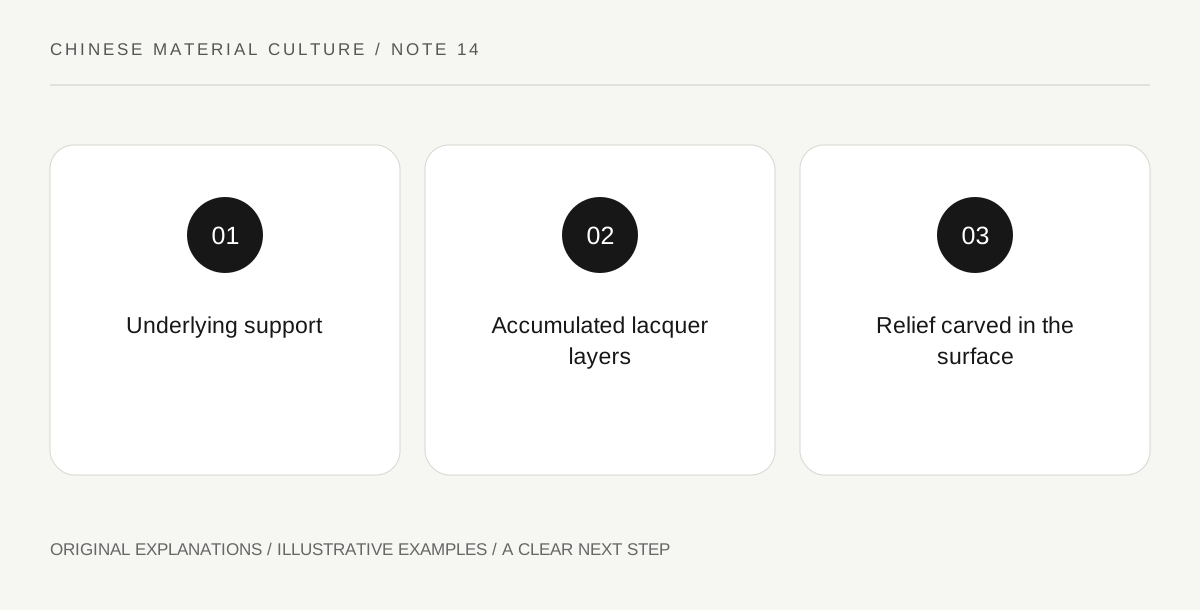
Original explanatory diagram. Read the full method and limitations below.
Separate the support from the worked layer
The Met’s carved-lacquer exhibition explains a layered material applied over a substructure, usually wood, and then carved. Draw the support as one shape and the accumulated outer material as another. The distinction matters because the visible relief is not simply the underlying wood covered with a thin red paint. At a museum, read the medium line and process explanation rather than identifying the construction from color alone. A red surface can appear on many materials, and a photograph cannot establish the depth or sequence of the worked layers without supporting information.
Use relief to ask about foreground and background
Study how a documented carved scene separates its main forms from surrounding areas. A figure, branch or geometric pattern may stand forward while the background is worked differently. Describe those relationships in plain words before assigning symbolic meaning. Relief is not only a decorative outline; it organizes depth across the object’s surface. A simple original cross-section can show a raised motif and a lower surrounding area within an exaggerated layer. Label that drawing as schematic. It should explain the concept of carving into built material without claiming to measure the structure of the historical object.
Keep the material process out of a casual DIY recipe
The museum account describes lacquer as a material whose properties and layered application are central to the craft. Raw materials, pigments, curing and carving require specialist knowledge and suitable precautions. This guide offers observation and paper diagrams rather than instructions for handling resin, powders or solvents. If attending a workshop, establish what materials participants actually use and whether the activity is a modern simulation or work with traditional materials. Both can be educational when accurately described. A quick decorative coating exercise should not be advertised as mastery of the long layered process merely because the sample is red.
Interpret a motif with its documented occasion
The Met’s exhibition connects some works with birthday gifts and identified symbols, illustrating how subject and use can be studied together. That does not mean every peach, bird or character on an unknown object carries the same specific history. Use the label for the particular piece and separate an attributed meaning from your visible description. If shopping, ask what is being sold: contemporary lacquer work, a different material made to resemble it or an object with a historical claim. Technique, age, condition and value are separate questions. Respect the surface by avoiding rubbing, scratching or cleaning experiments intended to reveal its construction.
Illustrative material section
A learner draws a bowl support in gray and a thick outer band in red, then sketches a shallow relief within that band. The layers are deliberately exaggerated and labeled as a teaching model. A note states that the lacquer, rather than the support, is the worked material in the documented technique. No resin handling or carving tools are needed.
Practical checks
Optional checkboxes save only in this browser.
Questions that come up
Is carved lacquer just painted carved wood?
That is not the layered technique described by The Met. Its account concerns lacquer built over a support and then carved, so the worked surface material is a central distinction.
Does every red carved object contain traditional lacquer?
No. Appearance alone does not establish composition or manufacture. Read a reliable material description and treat an unknown object’s construction as a question requiring evidence.
References and scope
These sources support the factual background. Examples and exercises are original illustrative teaching material. References do not imply endorsement.
- The Met: Chinese carved lacquer — Layered lacquer over a support and carving through the built material.