Chinese Filigree Inlay: Distinguish Fine Wire From Added Stones
A filigree-inlay object combines several kinds of skilled work that can merge visually into one ornate surface. Fine wire forms patterns, while settings and inserted materials add other elements. Separating those jobs helps you understand the construction without assuming that glitter or complexity proves the object’s age or material value.
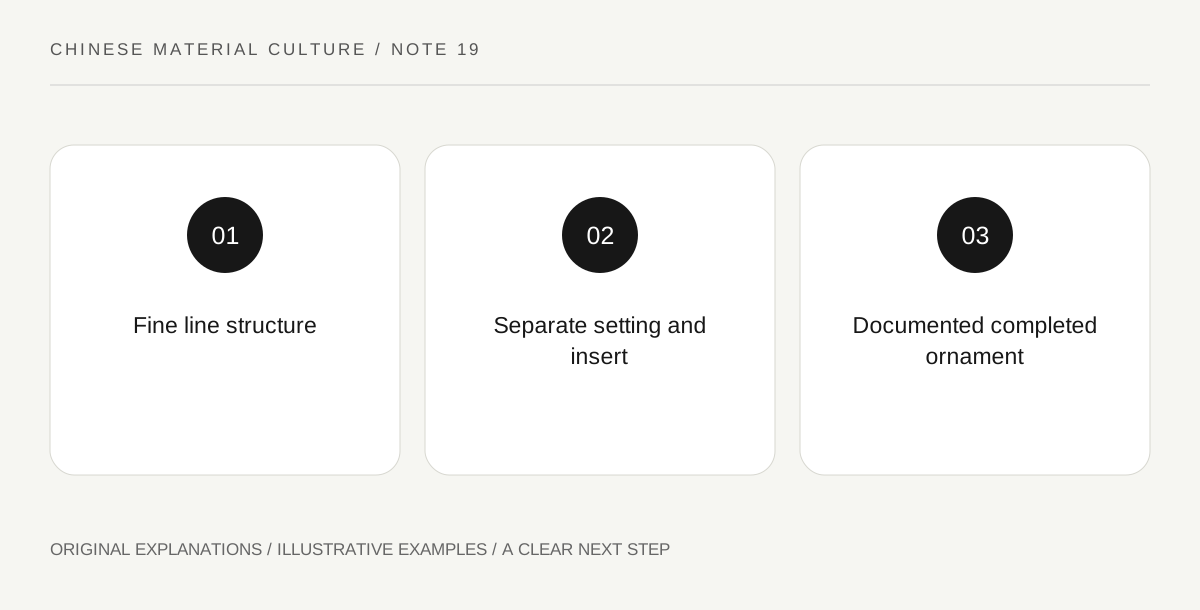
Original explanatory diagram. Read the full method and limitations below.
Read the wire as a structure of lines
Beijing’s official magazine describes filigree inlay through fine metal threads worked into elaborate patterns and combined with other materials. Begin by following one wire-like line in a clear image. Notice where it curves, repeats or meets another element. The visible pattern is not simply drawn decoration on a flat sheet. At the same time, a photograph alone may not reveal whether every line is separate wire, another metal process or a reproduction. Read the object’s medium and maker information before naming the complete construction. The first stage of looking is a question about how lines become a material surface.
Separate filigree work from the inlaid elements
A bright stone-like area and the surrounding metal can have different origins and techniques. Describe them in separate fields rather than calling the whole object gold jewelry or jade work. Ask what material the maker declares for the wire, support and inserted elements. Color is not enough to identify a precious metal or gemstone, and a traditional form does not establish legal or ethical sourcing for unspecified materials. A contemporary interpretation may choose different materials from a historic court object. That choice should be documented rather than concealed beneath an impressive craft label.
Use a drawing to distinguish line and insert
For an original paper exercise, draw a simple border with repeated loops and place a contrasting paper shape in its center. Label the looped line plan and the separate central insert. Then remove the insert and see how much structure belongs to the line arrangement itself. This is a visual model, not a jewelry-making plan, soldering lesson or historical ornament pattern. It helps a beginner avoid treating the colored centerpiece as the entire craft. Specialist metal joining, setting and tool work require qualified instruction; drawing the relationship already makes the division of tasks understandable.
Keep a court association specific to the documented work
The Beijing account discusses filigree inlay in relation to imperial adornments and identifies historical examples. That does not give every current ornament a palace provenance. Use the museum or maker record to distinguish historical object, contemporary handmade work and style-inspired souvenir. If considering a purchase, request a clear description of composition and process and understand what any appraisal or certificate actually covers. A beautiful object can be appreciated without a speculative age claim. The most useful craft note combines a traced line relationship, the declared inserted material and the object’s documented purpose rather than a list of grand adjectives.
Illustrative line-and-insert plan
A learner draws an original looped border around a plain paper oval, then makes a second version without the oval. The comparison shows how line work contributes even when the central color is removed. A separate note lists the materials declared for a documented object. The drawing is explicitly conceptual and carries no claim to function as wearable jewelry.
Practical checks
Optional checkboxes save only in this browser.
Questions that come up
Does gold-colored filigree prove the wire is gold?
No. Color cannot establish metal composition. Use reliable product or object documentation and appropriate expertise for valuable material claims.
Does an imperial-style ornament have to be an antique?
No. Historical forms can inspire contemporary work and souvenirs. Date and provenance require evidence independent of the design’s appearance.
References and scope
These sources support the factual background. Examples and exercises are original illustrative teaching material. References do not imply endorsement.
- Beijing magazine: toys and imperial crafts — Swallow-kite forms, filigree inlay and local craft context.