Chinese Cloisonné: See the Wire Compartments Beneath the Color
Cloisonné can look like painting on metal until you notice the fine boundaries organizing its colors. The wire partitions and enamel filling have different jobs. A documented vessel reveals how design, repeated firing and finishing cooperate to produce a surface that appears unified in the finished object.
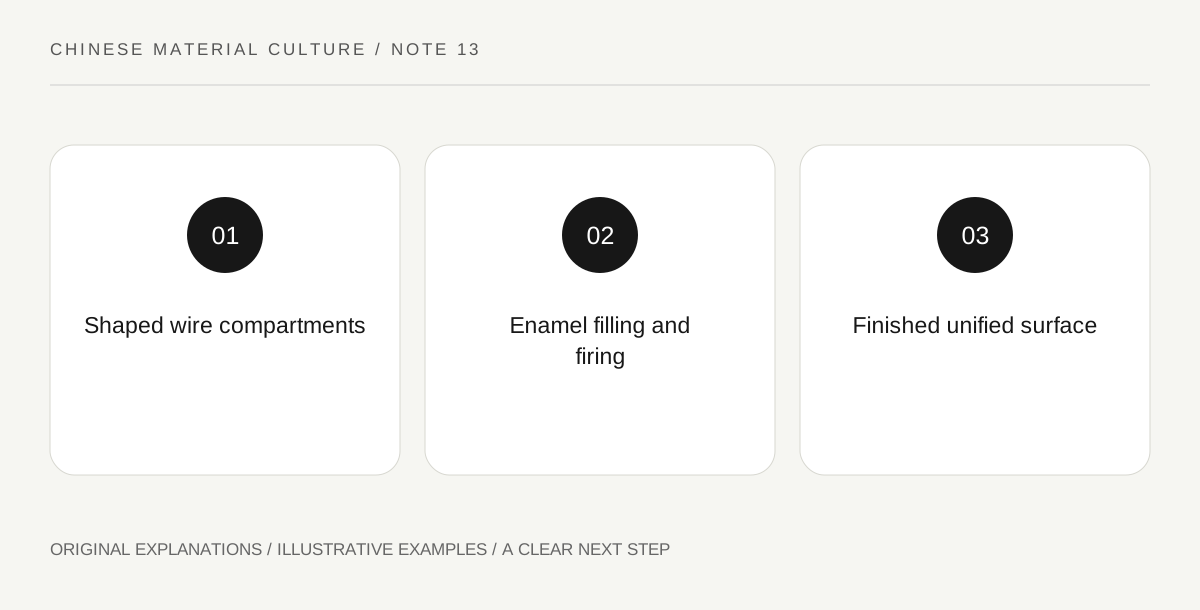
Original explanatory diagram. Read the full method and limitations below.
Identify the compartments before naming the motif
The Met describes cloisonné as colored glass paste placed within enclosures formed by shaped metal wires on a metal vessel. Start by following one boundary around a colored area in a permitted close view. Then look at how that cell joins neighboring areas to build the overall motif. A flower is the depicted subject; the network of compartments is part of how the subject is materially organized. Do not assume every colored metal object uses this method. Painted enamel and other techniques can have a different construction even when their palettes resemble a cloisonné example.
Understand filling and firing as repeated work
The museum account explains that enamel can shrink during firing and that filling and firing are repeated before the surface is finished. This makes the final smooth appearance evidence of a sequence rather than proof of one easy pour. In a workshop visit, ask which stage you are observing and whether the object is a demonstration piece or a finished product. Avoid translating a museum process description into a home recipe. Kilns, metal preparation and enamel materials require specialist practice; an explanatory drawing already allows a beginner to understand why the surface contains both color and visible partitions.
Use a cell diagram to explain the design
Draw an original outline with several broad enclosed areas, then color each cell while leaving the boundaries visible. Label the boundaries as a schematic stand-in for wire and the filled regions as a stand-in for enamel. The paper drawing does not reproduce the physical material or demonstrate firing, but it makes the partition logic explicit. Add one small open boundary in a second drawing and ask why containment would now be a different problem. Keep this as a conceptual exercise rather than claiming that a marker drawing is a traditional cloisonné pattern or a functional manufacturing plan.
Read material, condition and purpose separately
The object’s form and decoration can help you appreciate it, while its material and date come from the record. A bright palette or familiar blue ground does not prove a particular reign or workshop. For a current purchase, ask what materials and methods the maker declares and whether the vessel is intended for display or another use. Do not perform scratch, heat or chemical tests on an object to satisfy curiosity. Surface damage and repairs also require appropriate assessment rather than a casual conclusion from one image. A useful description distinguishes observed wire boundaries, documented composition and any remaining uncertainty about history or condition.
Illustrative partition drawing
A learner draws an original five-petal flower as separate closed color cells and keeps a dark line visible around each. A second version leaves one cell boundary open to make the containment question visible. The caption explains that the drawing models the relation between partition and fill, while the museum’s vessel supplies the documented material process.
Practical checks
Optional checkboxes save only in this browser.
Questions that come up
Is every enamel object cloisonné?
No. The technique described here uses wire compartments to organize enamel. Read the material record for the actual object instead of classifying all colored metalwork by palette alone.
Does a smooth surface mean there were no partitions?
Not necessarily. The museum describes finishing that exposes the wire edges within the completed surface. Look closely at documented boundaries rather than assuming smoothness means ordinary paint.
References and scope
These sources support the factual background. Examples and exercises are original illustrative teaching material. References do not imply endorsement.
- The Met: cloisonné altar incense burner — Wire compartments, enamel filling, repeated firing and finishing.