Kesi: When a Picture Is Woven and Some Details Are Painted
A silk picture that resembles a painting may actually be a tapestry, and a woven picture may also contain painted details. Kesi rewards that careful distinction. Read a documented object’s material record before deciding how every visible line was made or treating all textile pictures as embroidery.
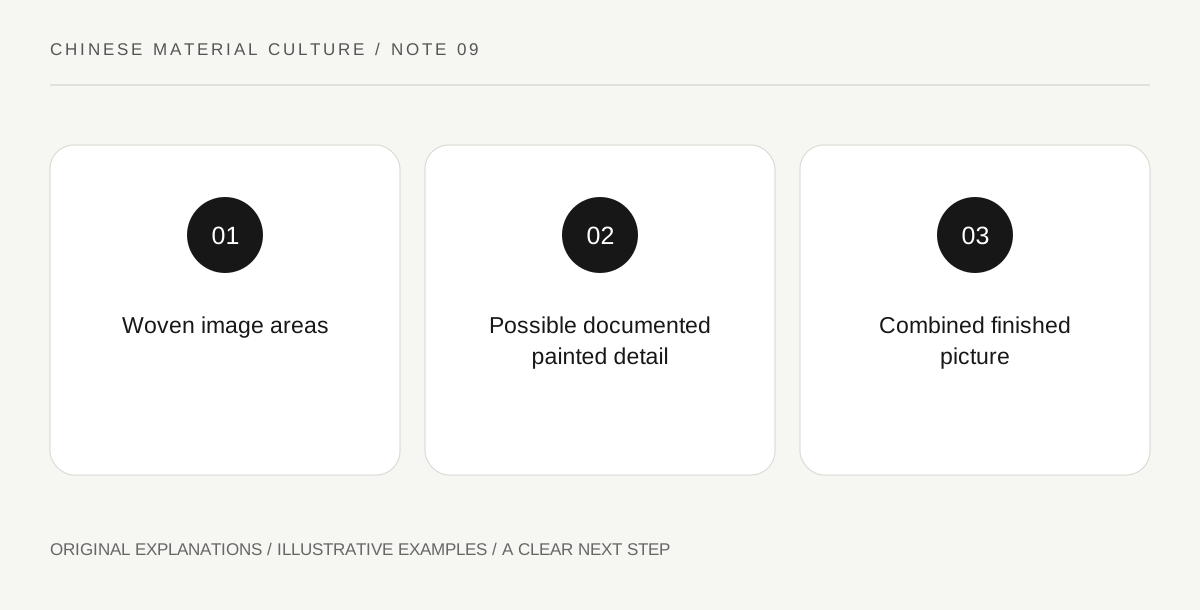
Original explanatory diagram. Read the full method and limitations below.
Identify the support and the image-making method
The Met identifies Two Pheasants on a Rock as silk and metal-thread tapestry, or kesi, with ink and color. That material line establishes a combination rather than a single technique. Begin with the cloth structure and then ask how the image is formed within or above it. A photograph of a bird can conceal the difference between woven color, embroidery and pigment. Keep the museum’s terminology beside the title. The subject depicted is one kind of information; the material means used to depict it are another, and both are needed for a useful craft description.
Look for an image built through colored thread
In a tapestry-based picture, different areas can be formed with colored threads as part of the weaving. A simple original diagram can illustrate this by dividing a landscape into a sky area, a rock and a bird silhouette, then labeling those as planned woven areas. Do not present the diagram as a complete kesi pattern or a loom-ready set of instructions. Its purpose is showing why making an image with thread entails choices of boundary and placement. Those choices differ from moving a brush across a completed blank sheet, even if the resulting subject looks painterly from a distance.
Allow painted detail where the record documents it
For its nineteenth-century pheasant picture, The Met explains that some details, including waves on a larger woven area, were painted after weaving. That observation should make you more precise, not suspicious of every textile image. A work can deliberately combine methods, and the medium line may tell you so. Do not claim that a visible detail must be woven simply because the object is called kesi. Equally, do not relabel the whole work as an ordinary painting because pigment appears somewhere. Describe which relationship the object record supports and leave unconfirmed areas as questions.
Compare at two scales without testing the object
At a broad view, study composition: where the main figures sit, how the landscape recedes and what remains relatively open. In a high-resolution image or permitted close view, examine how small detail relates to that overall arrangement. Use the documented medium to guide the looking rather than touching, flexing or pulling threads to investigate. For a contemporary purchase, ask whether the offered work is woven, embroidered, printed, painted or a combination, and what the seller’s description covers. Price and a silk label do not answer the construction question. A clear account of technique makes appreciation more specific without pretending to authenticate the work from a screen.
Illustrative two-layer image plan
A learner draws a simple landscape and marks three broad areas as a hypothetical woven plan. A second transparent overlay adds a few painted ripples. Both layers are labeled as an original explanatory diagram inspired by the documented combination of methods, not a historical pattern. The learner then compares that diagram with the museum’s material description.
Practical checks
Optional checkboxes save only in this browser.
Questions that come up
Is every picture made on silk an embroidery?
No. Silk can be woven into an image, embroidered, painted or combined with other methods. Read the object’s material and construction description.
Does painted detail mean a kesi work is mislabeled?
Not necessarily. The Met’s documented example combines tapestry with ink and color. A precise label can acknowledge both instead of forcing the object into one exclusive process.
References and scope
These sources support the factual background. Examples and exercises are original illustrative teaching material. References do not imply endorsement.
- The Met: Two Pheasants on a Rock — Kesi tapestry with ink and color; woven image and painted details.