Li Textiles: Read Spinning, Dyeing, Weaving and Embroidery Together
Traditional Li textiles from Hainan bring several skills into one material culture. A finished patterned cloth may embody choices made long before the visible motif appears. Reading those stages together also helps keep community knowledge attached to the textile rather than turning its patterns into anonymous decorative graphics.
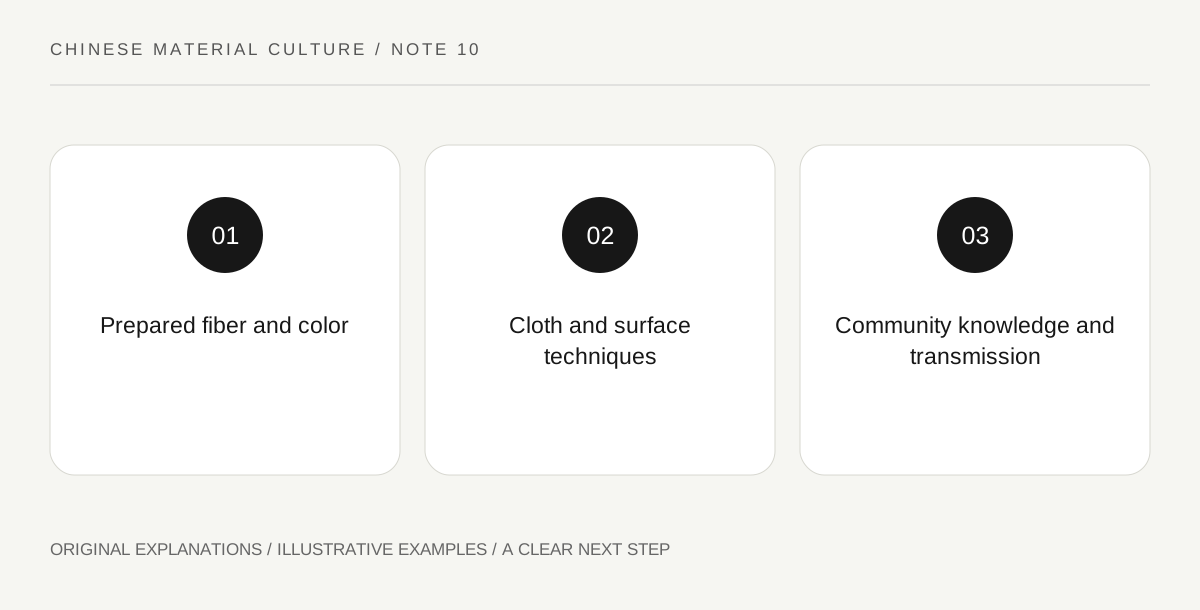
Original explanatory diagram. Read the full method and limitations below.
Start with the complete chain of skills
UNESCO’s current account names spinning, dyeing, weaving and embroidery as related Li textile techniques. These are distinct operations that can contribute to one object. A fiber becomes usable thread, color is introduced, cloth is structured and additional work may further shape its surface. Do not assume that every individual textile displays each operation in the same way. Ask the label or maker which techniques the particular object uses. A sequence diagram is useful here because it keeps the thread’s preparation visible rather than beginning the story only when the pattern attracts a visitor’s attention.
Keep material and technique separate in your notes
The heritage account mentions cotton, hemp and other fibers. Those are material categories, while weaving and embroidery describe processes. A cotton textile is not automatically plain, and an ornate textile is not automatically silk. Write two fields, what it is made from and how it is made, before describing the motif. If the label is incomplete, preserve that uncertainty rather than filling it with a generic exotic-fabric claim. A close photograph can show surface relationships but cannot reliably identify all fibers. The distinction prevents material assumptions from becoming the basis of a misleading purchase or caption.
Treat patterns as situated knowledge
UNESCO describes patterns as carrying histories, legends and other aspects of Li culture. That should encourage attention to a named community and explanation, not the belief that any viewer can decode every geometric shape. Record a meaning when it is supplied by a reliable source and keep its attribution visible. An original classroom arrangement of colored squares can demonstrate repetition without being called a Li motif. Do not extract a specific cultural design from a garment and market it as a universal decorative symbol with an invented meaning. Learning about form is compatible with acknowledging the limits of your knowledge.
Describe transmission as a living process
The current UNESCO account discusses strengthened intergenerational learning and broader participation over time. That makes an old statement about practitioner numbers or gender roles unsuitable as an unchanging description of the present. In a demonstration, ask who teaches, how learners practice and which stages are shown. Keep the answer connected to that program. A contemporary product or new teaching format does not automatically erase cultural continuity, but a printed motif alone also does not establish the full inherited process. Read maker, materials, construction and community context together when deciding how to describe the textile.
Illustrative textile label
A visitor creates four fields for a documented cloth: fiber, construction methods, maker or community and attributed pattern explanation. One field remains unknown because the label does not supply it. The visitor adds a simple diagram of the linked skill stages while explicitly keeping the diagram separate from a claim that every stage appears visibly in that one object.
Practical checks
Optional checkboxes save only in this browser.
Questions that come up
Are all Li textiles made from silk?
No. The cited heritage account includes cotton, hemp and other fibers. Identify the actual object’s materials instead of equating elaborate pattern with silk.
Can I explain a motif from its shape alone?
A visible shape can be described, but cultural meaning needs a reliable explanation in context. Keep observation and attributed interpretation separate, and leave unknown meanings unknown.
References and scope
These sources support the factual background. Examples and exercises are original illustrative teaching material. References do not imply endorsement.
- UNESCO: traditional Li textiles — Spinning, dyeing, weaving, embroidery and community meaning.