Chinese Silk Craftsmanship: Keep the Cocoon, Thread and Cloth Distinct
Silk begins before weaving and does not become a finished fabric in a single step. Chinese sericulture connects cultivation, silkworm care, reeling, thread preparation and textile design. Following that chain makes a workshop demonstration or product label much easier to understand without treating every glossy material as equivalent.
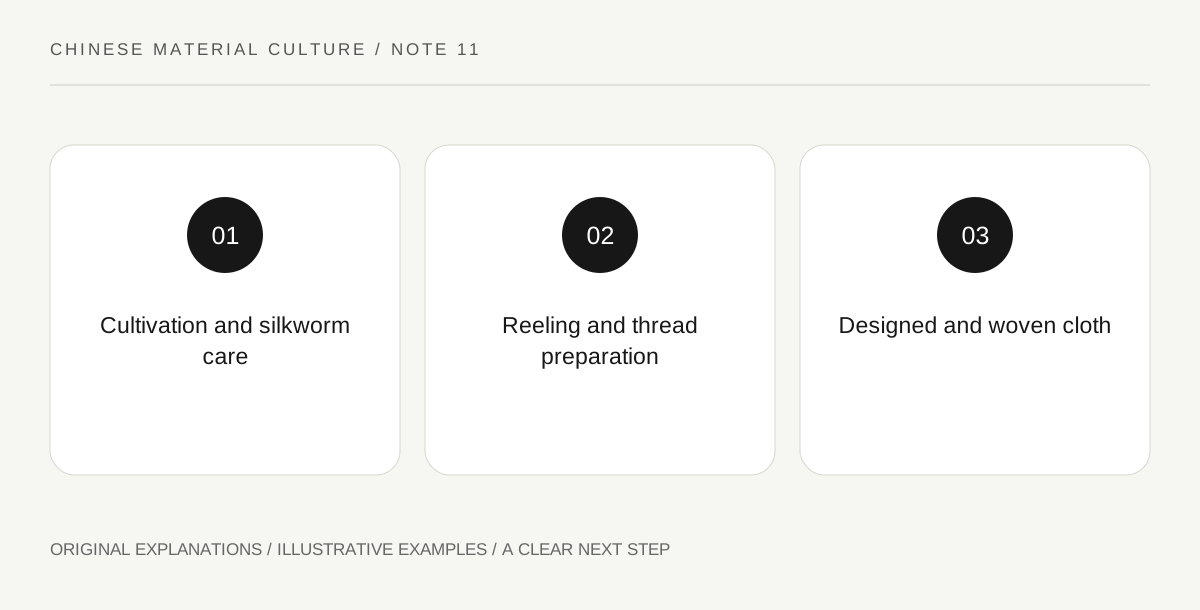
Original explanatory diagram. Read the full method and limitations below.
Begin before the loom
UNESCO’s account describes mulberry cultivation and silkworm raising as part of the craft system, followed by reeling silk, making thread and designing and weaving fabric. Put those stages in order before looking at a loom demonstration. A cocoon displayed beside a finished scarf is an invitation to ask about the intermediate work, not evidence that the scarf emerged directly from the cocoon. A simple chain diagram makes the missing transformations visible. This is a cultural production account rather than a home insect-rearing guide; the practical conditions and responsibilities involved in raising animals are not covered by a short textile introduction.
Distinguish reeling from making a textile
Reeling concerns obtaining silk from the cocoon, while later thread and cloth preparation create materials suitable for particular uses. In a demonstration, ask which transformation is happening and what has already been prepared. A machine or tool moving a fine strand should not automatically be described as weaving. Likewise, a completed cloth with a silk label may involve additional structures or finishes not shown in a short visit. Naming the stage accurately helps you appreciate specialized skill and avoids compressing several occupations into one picturesque moment of handwork for a visitor’s camera.
Read fiber content and fabric structure separately
Silk identifies a fiber category, not one compulsory weave, thickness or pattern. A product can use silk in a blend or in a particular component, so read the composition statement and ask what it applies to. Then consider how the cloth is structured and what use the maker intends. Smoothness and shine alone cannot establish content or quality. If looking at a museum textile, use its material record rather than a touch test. For a contemporary purchase, retain the label and care instructions so the attractive story of a cocoon is supported by practical information about the object you actually own.
Connect the chain with people and local practice
The heritage account situates silk craftsmanship within families, apprenticeships and community knowledge, including social practices around production. Do not present one ritual or landscape cycle as something every silk-producing community performs identically today. Ask a local institution or demonstrator about the practice it is documenting. A finished object can connect agricultural work with design and skilled manufacture without requiring a romantic claim that all stages were completed by one person. A careful description names the stages you have evidence for and distinguishes them from operations merely represented by props in a visitor display.
Illustrative workshop diagram
A visitor labels five boxes: mulberry cultivation, silkworm raising, reeling, thread preparation and cloth making. The workshop demonstrates only reeling and weaving, so those boxes are marked observed demonstration while the others remain documented background. The finished scarf’s own label supplies its fiber composition. The diagram avoids implying that every stage occurred in front of the visitor.
Practical checks
Optional checkboxes save only in this browser.
Questions that come up
Does a silk label describe a particular weave?
No. Fiber content and fabric structure answer different questions. Read both the composition and the product description before assuming how a textile is constructed.
Does a cocoon beside a scarf prove its complete production history?
No. It can illustrate the material chain, but the specific object needs its own description. Establish which stages the workshop actually performs and which are explained as background.
References and scope
These sources support the factual background. Examples and exercises are original illustrative teaching material. References do not imply endorsement.
- UNESCO: sericulture and silk craftsmanship — Mulberry cultivation, silkworm raising, reeling, thread and cloth.