Nanjing Yunjin Brocade: Understand the Work Shared Across a Loom
Yunjin brocade is not embroidery added to an already finished cloth. Its pattern is produced through an organized weaving process, and the documented tradition includes coordinated work by two craftspeople. Seeing the loom as a working relationship makes the finished textile’s complexity easier to appreciate.
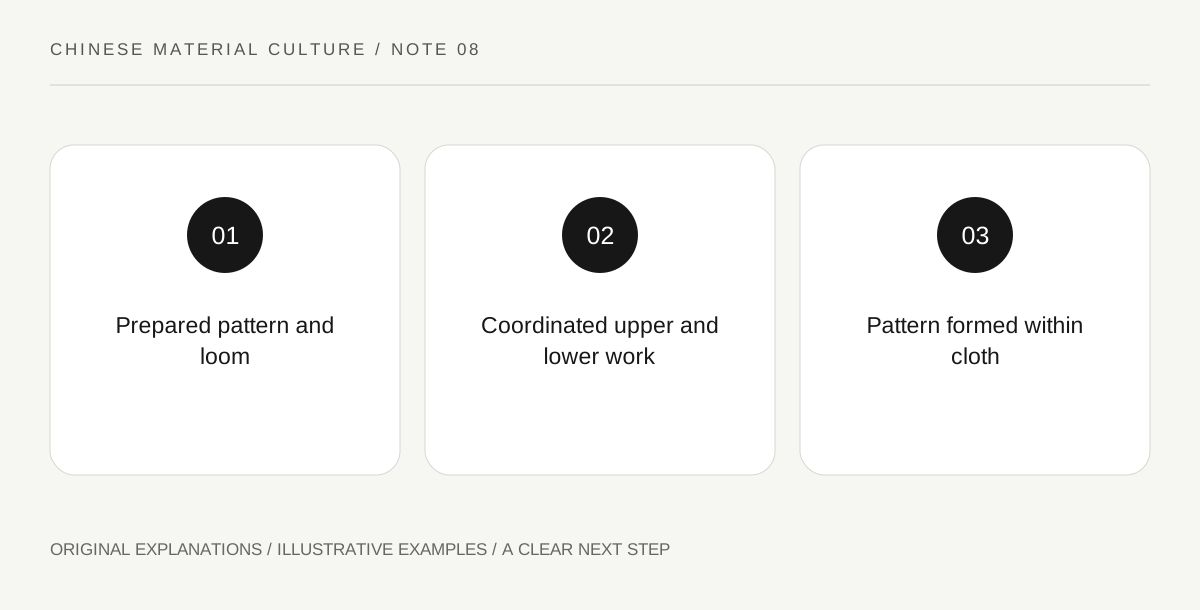
Original explanatory diagram. Read the full method and limitations below.
Distinguish woven pattern from added stitching
UNESCO’s account places Yunjin within weaving and describes preparation of patterns and a complex loom. Begin by asking whether the image or motif is formed as the cloth is woven or added afterward. That distinction is more useful than calling any ornate silk embroidery. A woven patterned textile can also receive later additions, so read the object’s material record before drawing a complete conclusion. In a demonstration, look for the relationship between lengthwise threads, crosswise insertion and the emerging patterned area. The finished front face is only one view of the underlying structure.
Notice why two positions need coordination
The heritage description identifies two craftspeople working upper and lower parts of the loom. Use that fact to ask how one person’s action prepares the next action of the other. Do not reduce the demonstration to a contest of speed. Coordination can be a form of skill that is difficult to see when attention stays on one pair of hands. Ask the demonstrators to explain their roles at a suitable pause rather than interrupting a sequence. A drawing with two labeled positions and arrows for their interaction can communicate the teamwork without pretending to be a complete loom diagram.
Put pattern preparation before visible weaving
The UNESCO account includes drafting patterns, preparing the loom and other procedures before the cloth emerges. That helps explain why watching a short weaving segment does not reveal the whole time or expertise invested. Ask what determines the next pattern change and how its instructions were prepared. Keep any modern equipment or adaptation described by the maker visible in your notes rather than assuming every workshop is unchanged from an imperial past. A traditional craft can preserve important knowledge while serving contemporary uses. Describing the actual process is more accurate than treating every innovation as evidence against the craft’s identity.
Read materials and purpose with equal care
The cited tradition includes elaborate materials and historical use for royal garments as well as contemporary work. A shiny thread in a photograph cannot independently establish its metal content, and a dragon motif does not prove court provenance. Use the label for composition and the object record for date and use. When purchasing a current textile, ask which parts are hand-produced and how the seller describes the item. A small souvenir, a complex commissioned cloth and a historical museum garment can all prompt interest in Yunjin, but they should not be collapsed into one claim of material, labor or status.
Illustrative loom observation
A visitor sketches two positions at a demonstrated loom and writes one sentence about how their actions depend on each other. Beside the sketch, the visitor lists pattern preparation and loom setup as prior work. The finished sample is described using the maker’s stated materials. No estimate of production time or imperial provenance is invented from the brief demonstration.
Practical checks
Optional checkboxes save only in this browser.
Questions that come up
Is Yunjin an embroidery technique?
The cited heritage description concerns brocade weaving. An ornate surface should not automatically be called embroidery; establish how its pattern is formed.
Does a gold-colored thread prove the textile contains gold?
No. Appearance is not a material assay. Use a reliable composition description and distinguish it from the visual effect of a shiny thread.
References and scope
These sources support the factual background. Examples and exercises are original illustrative teaching material. References do not imply endorsement.
- UNESCO: Nanjing Yunjin brocade — Two-person loom, pattern preparation and weaving collaboration.