Shanghai Velvet Embroidery: Build a Picture Through Thread and Tone
A textile picture can communicate volume through many small changes of color and direction. Shanghai-style velvet embroidery offers a particular example of that approach, with wool thread and a local history of adapting imported and Chinese techniques. Read the named medium before assuming a painted-looking image is silk or pigment.
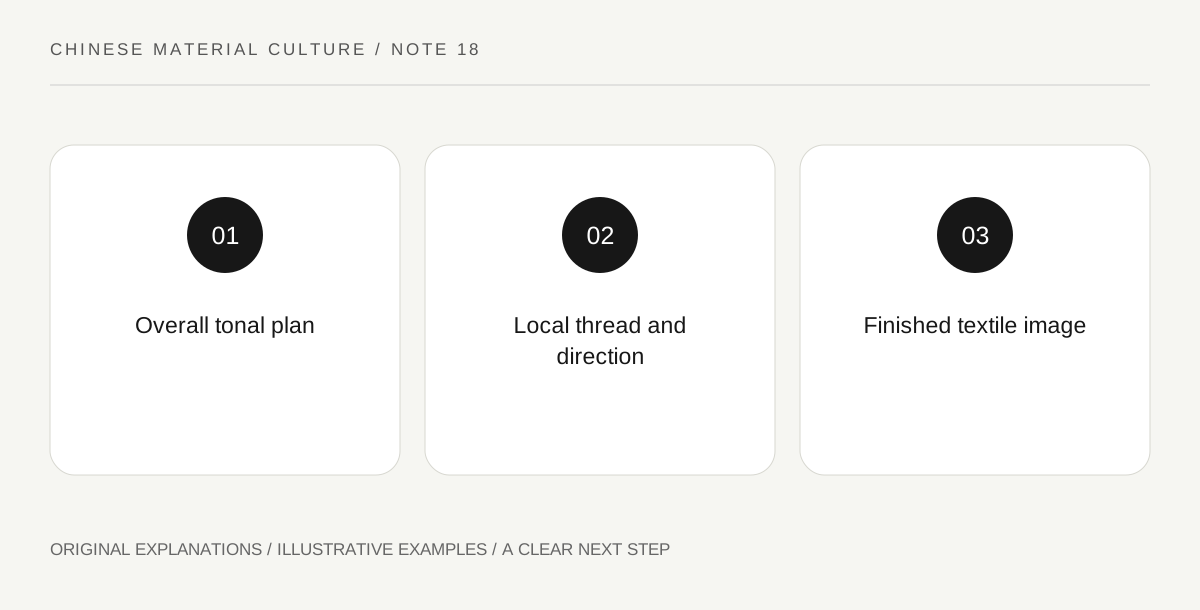
Original explanatory diagram. Read the full method and limitations below.
Clarify what velvet embroidery means in this account
Shanghai’s official craft description identifies a wool-thread practice and discusses the meeting of Western wool embroidery with Chinese needlework. That is more specific than the English word velvet might suggest. Begin with the actual material description, since the title alone could make a beginner imagine pile fabric, silk thread or an entirely different construction. Keep the local term and institutional explanation together in your notes. A modern work may vary, so use its own medium line rather than assuming that every soft-looking textile picture belongs to this particular Shanghai practice.
Compare broad tone before individual stitches
At a distance, identify the main light and dark regions of a documented embroidered image. Ask how those areas make a face, object or landscape appear to have volume. Then inspect a permitted close image to see how thread contributes to the transitions. A polished portrait can make the medium less obvious when viewed small on a screen. Do not treat the disappearance of visible stitches at a distance as proof that no handwork is present. The useful comparison moves between overall tonal organization and local material detail, keeping the two scales connected.
Make a color-map exercise without copying a portrait
Choose an original simple sphere or folded-paper shape and draw a small plan containing a few clearly separated light-to-dark areas. Represent each area with paper swatches or colored-pencil hatching. The exercise is a planning analogy, not an embroidery pattern and not a reconstruction of a named artist’s portrait. Give each swatch a location and direction so you can see how local marks contribute to the whole image. If undertaking actual needlework, use appropriate instruction and materials. A paper tone map already teaches why an apparently smooth gradient can depend on many discrete choices.
Describe adaptation without inventing an unbroken origin
The Shanghai account identifies a local development involving exchange and adaptation. That makes the tradition more specific, not less worthy of attention. Avoid calling every material or method uniquely ancient Chinese when the documented history is more complicated. Equally, do not reduce the local practice to a copy of an imported craft when artists have developed their own work. For a contemporary object, name the maker, medium and declared process where available. If a seller says handmade, ask which stages that describes. A printed reproduction of an embroidery can represent its image without being the same material object, and the distinction belongs in an honest caption.
Illustrative tone plan
A learner draws an original sphere using five broad tone areas and assigns a paper swatch to each. Small hatching marks show a proposed direction within the areas. The plan is compared with a documented velvet-embroidery image to understand overall tone and local thread decisions. It is labeled an explanatory exercise, with no claim to reproduce the artist’s design or method.
Practical checks
Optional checkboxes save only in this browser.
Questions that come up
Does velvet embroidery necessarily mean stitching on velvet fabric?
Do not infer the medium from the English title alone. The cited Shanghai account describes a wool-thread practice. Use the specific work’s material description.
Is a print of an embroidered picture the same kind of object?
No. It can reproduce the image while using a different material process. Identify the reproduction and distinguish it from an actual stitched textile.
References and scope
These sources support the factual background. Examples and exercises are original illustrative teaching material. References do not imply endorsement.
- Shanghai: lantern and velvet-embroidery crafts — Wire-frame animal lanterns and wool-based velvet embroidery.